
GD: Bones 4
Quiz Summary
0 of 51 Questions completed
Questions:
Information
You have already completed the quiz before. Hence you can not start it again.
Quiz is loading…
You must sign in or sign up to start the quiz.
You must first complete the following:
Results
Results
0 of 51 Questions answered correctly
Your time:
Time has elapsed
You have reached 0 of 0 point(s), (0)
Earned Point(s): 0 of 0, (0)
0 Essay(s) Pending (Possible Point(s): 0)
Categories
- Not categorized 0%
- 1
- 2
- 3
- 4
- 5
- 6
- 7
- 8
- 9
- 10
- 11
- 12
- 13
- 14
- 15
- 16
- 17
- 18
- 19
- 20
- 21
- 22
- 23
- 24
- 25
- 26
- 27
- 28
- 29
- 30
- 31
- 32
- 33
- 34
- 35
- 36
- 37
- 38
- 39
- 40
- 41
- 42
- 43
- 44
- 45
- 46
- 47
- 48
- 49
- 50
- 51
- Current
- Review
- Answered
- Correct
- Incorrect
-
Question 1 of 51
1. Question
The crystal that makes bone hard is a pentagon-shaped crystal called hydroaxle-appetite
CorrectIncorrectHint
Find the answer in section A: Click here
-
Question 2 of 51
2. Question
The chemical formula for the bone crystal is Ca5(PO4)3(OH). It has more than twice as much of the wild metal phosphorous as there is calcium.
CorrectIncorrectHint
Find the answer in section B: Click here
-
Question 3 of 51
3. Question
Phosphate, PO4, is critically important in fertilizers and is also part of the backbone that makes the outside of the double-helix spiral of DNA. In addition, phosphate is a critical component of the bone crystal.
 CorrectIncorrect
Hint
Find the answer in section B: Click here
-
Question 4 of 51
4. Question
Phosphorus is used for smoke bombs in the military because it emits so much smoke. It’s been also used in grenades and in bombs. Phosphorus was a tremendous help in the invasion of the allies at Normandy and in the march across France to Germany and Greece because it could be used to take out tanks.
 CorrectIncorrect
Hint
Find the answer in section B: Click here
-
Question 5 of 51
5. Question
Osteon logs lie perpendicular to the length of the bone they are in. An osteon is about the size of an upper eyelash.
CorrectIncorrectHint
Find the answer in section B: Click here
-
Question 6 of 51
6. Question
Lamellae rings in the osteons grow in concentric circles. There can be 20 or more of these rings in each osteon.
 CorrectIncorrect
Hint
Find the answer in section C: Click here
-
Question 7 of 51
7. Question
To make compact bone, parallel collagen molecules are put into place by the osteoblasts. These look a little like train tracks. The spacing between the molecules is an incredibly tiny distance of 40 nm! The bone crystal is just 3 times larger than a glucose molecule which is 1 nm.
 CorrectIncorrect
Hint
Find the answer in section D: Click here
-
Question 8 of 51
8. Question
The 3 nm bone crystal that is laid down in the collagen matrix in bone is regulated in size by citrate which is put over 1/6th of the crystal.
CorrectIncorrectHint
Find the answer in section D: Click here
-
Question 9 of 51
9. Question
The genetic code of people contains roughly 30,000 protein-coding regions. This is seemingly a very small number of genes for what the DNA puts together in our bodies. The complete code had to be small enough to tuck inside a cell or there would be no life. The DNA code that builds amazing horses is the same. It must fit into a cell or there would be no horses!
 CorrectIncorrect
Hint
Find the answer in section E: Click here
-
Question 10 of 51
10. Question
Our DNA builds 500,000 miles of blood vessels as well as the same amount for nerves. And the code to do this is on the human DNA strand.
CorrectIncorrectHint
Find the answer in section E: Click here
-
Question 11 of 51
11. Question
Our teeth have the same crystal, hydroxyapatite, as our bones do. But our teeth have more collagen proteins. Therefore they are harder and less flexible.
 CorrectIncorrect
Hint
Find the answer in section F: Click here
-
Question 12 of 51
12. Question
Dentin is the harder part to the tooth. It is the outer coating of every tooth.
CorrectIncorrectHint
Find the answer in section F: Click here
-
Question 13 of 51
13. Question
Teeth have blood vessels and nerves running into a “cave” in the inside of the tooth. The tooth itself is imbedded into a jaw which has trabecular bone.
CorrectIncorrectHint
Find the answer in section F: Click here
-
Question 14 of 51
14. Question
Which have greater beauty in their smiles? A chimp or a person. Think hard! If you miss this one you are in bad shape!
 CorrectIncorrect
Hint
Find the answer in section G: Click here
-
Question 15 of 51
15. Question
If DNA wasn’t damaged, our bones could last for a million years because they are continually being remade.
CorrectIncorrectHint
Find the answer in section H: Click here
-
Question 16 of 51
16. Question
Within a few hours after a bone is broken, phagocitoes begin to clean bone fragments and kill bacteria.
 CorrectIncorrect
Hint
Find the answer in section I: Click here
-
Question 17 of 51
17. Question
The word phagocyte means “cells that eat” in Hebrew.
CorrectIncorrectHint
Find the answer in section I: Click here
-
Question 18 of 51
18. Question
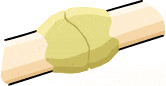
In a broken bone, a soft callus made mostly of cellulose is created around the fracture by another special group of cells called chondroblasts.
 CorrectIncorrect
Hint
Find the answer in section I: Click here
-
Question 19 of 51
19. Question
Special cells–the osteoclasts–mold the new bone to its original shape. Bone remodeling can take anywhere from 3 to 9 years to complete!
 CorrectIncorrect
Hint
Find the answer in section I: Click here
-
Question 20 of 51
20. Question
Woven bone is produced when osteoblasts produce “bone” rapidly. This woven bone is later replaced by much stronger compact bone.
CorrectIncorrectHint
Find the answer in section J: Click here
-
Question 21 of 51
21. Question
Bone with lamellae is highly organized in concentric rings. The even the fibers of collagen are arranged in a way to make the bone stronger.
CorrectIncorrectHint
Find the answer in section J: Click here
-
Question 22 of 51
22. Question
Laying down collagen fibers correctly in bone is no speedy job. This time-consuming process slows the formation of compact bone to about 200 microns per day.
CorrectIncorrectHint
Find the answer in section J: Click here
-
Question 23 of 51
23. Question
The osteoclasts secrete vesicles (bags) which break. The broken bags act as the places for calcium and phosphate to be deposited. The crystals gradually grow into place.
 CorrectIncorrect
Hint
Find the answer in section J: Click here
-
Question 24 of 51
24. Question
The living imprisoned cells in bone are the:
 CorrectIncorrect
Hint
Find the answer in section K: Click here
-
Question 25 of 51
25. Question
Osteocytes can “read” chemical messages and piezo-electric fields.
CorrectIncorrectHint
Find the answer in section K: Click here
-
Question 26 of 51
26. Question
There are billions of living imprisoned cells your bones.
CorrectIncorrectHint
Find the answer in section K: Click here
-
Question 27 of 51
27. Question
Without the buried osteocytes reading bone-generated electrical fields correctly, people’s bones would break down years before they turned 20 years old. Feats like what this gymnast is doing would be impossible.
 CorrectIncorrect
Hint
Find the answer in section L: Click here
-
Question 28 of 51
28. Question
Your femur bone makes an astonishing 65º angle into your pelvis.
 CorrectIncorrect
Hint
Find the answer in section M: Click here
-
Question 29 of 51
29. Question
The femur bone has a head of solid compact bone.
CorrectIncorrectHint
Find the answer in section M: Click here
-
Question 30 of 51
30. Question
The thigh bones fit nicely into the pelvis with ball joints like your elbow has. This ball joint allows the leg to swing around in circles.(Research if you need to.)
CorrectIncorrectHint
Find the answer in section N: Click here
-
Question 31 of 51
31. Question
Without the 45º head of your femur, your legs would rub each other constantly.
CorrectIncorrectHint
Find the answer in section N: Click here
-
Question 32 of 51
32. Question
The DNA code builds astonishing ligaments that hold your hips together with great strength!
CorrectIncorrectHint
Find the answer in section O: Click here
-
Question 33 of 51
33. Question
Spongy bone, trabecular bone and compact bone are the same mesh-type bone.
CorrectIncorrectHint
Find the answer in section O: Click here
-
Question 34 of 51
34. Question
Your hips are called your pelvis.
 CorrectIncorrect
Hint
Find the answer in section O: Click here
-
Question 35 of 51
35. Question
There are more than five ligaments holding your femur to your pelvis.
CorrectIncorrectHint
Find the answer in section P: Click here
-
Question 36 of 51
36. Question
The angles of the tendons and ligaments and their thicknesses and their structure–whether wide or thin–is all engineered by the DNA. So are all the muscle and tendon structures of the body and all the angles that muscles hook to bone.
 CorrectIncorrect
Hint
Find the answer in section P: Click here
-
Question 37 of 51
37. Question
There is a ligament inside the hip ball joint holding the femur in place.
CorrectIncorrectHint
Find the answer in section P: Click here
-
Question 38 of 51
38. Question
The knee cap has a muscle attaching to it from the top and bottom. (Refer to the picture below)
 CorrectIncorrect
Hint
Find the answer in section Q: Click here
-
Question 39 of 51
39. Question
The muscles for the fingers are in the forearm. (Refer to the picture above.)
CorrectIncorrectHint
Find the answer in section Q: Click here
-
Question 40 of 51
40. Question
Everyone has a 6-pack of abdominal muscles. Whether or not you see them is dependent upon how built up they are and how much fat is under the skin.. (Refer to the picture above. Think!)
CorrectIncorrectHint
Find the answer in section Q: Click here
-
Question 41 of 51
41. Question
There are 3 muscles holding the head on the upper torso of the body.(Refer to the picture above.)
CorrectIncorrectHint
Find the answer in section Q: Click here
-
Question 42 of 51
42. Question
There are multiple white ligaments wrapping the top of the ankle to help make the ankle more solid. The achilles tendon moves from the heel to mid-calf where it fans out.
CorrectIncorrectHint
Find the answer in section Q: Click here
-
Question 43 of 51
43. Question
Muscles from your shoulder move down your back and widen to attach the back muscles to a long spot going down from the top to the middle of your back. Other muscles go from the shoulder area in the back from under other muscles. These fan out and attach even lower to the middle of your back. (See picture below and one in article.)
 CorrectIncorrect
Hint
Find the answer in section Q: Click here
-
Question 44 of 51
44. Question
There are at least 6 muscles pulling on your smile from each side of your mouth.
CorrectIncorrectHint
Find the answer in section Q: Click here
-
Question 45 of 51
45. Question
There are muscles that go around your eyes…one major one goes around the top of the eye and 15 major ones go around the bottom.
CorrectIncorrectHint
Find the answer in section Q: Click here
-
Question 46 of 51
46. Question
There are muscles from the bottom of your chin up to below your lips that you can tighten and make your chin a little hard. (Look at the picture and try it!) There are also two muscles that go from the bottom of your nose around your mouth and attach under your chin.
CorrectIncorrectHint
Find the answer in section Q: Click here
-
Question 47 of 51
47. Question
Where are the leg muscles of a horse?
CorrectIncorrectHint
Find the answer in section R: Click here
-
Question 48 of 51
48. Question
What are the white “strings “ in the lower calf of the legs of the horse?
CorrectIncorrectHint
Find the answer in section R: Click here
-
Question 49 of 51
49. Question
Just under the eye there is a muscle that looks round in this picture. This is the muscle that squeezes the jaw together. There are also muscles that stretch from the horse’s ears to its mouth.
 CorrectIncorrect
Hint
Find the answer in section R: Click here
-
Question 50 of 51
50. Question
The little muscles that are barely visible below the ear and above it are to orient and twitch the ear, like horses do when they try to get rid of flies. There are also several tendons going from the mouth area to further up on the snout.
CorrectIncorrectHint
Find the answer in section R: Click here
-
Question 51 of 51
51. Question
List 5 summaries of the devotional parts in this article and give a different personal application to each.
-
This response will be awarded full points automatically, but it can be reviewed and adjusted after submission.
Grading can be reviewed and adjusted.Grading can be reviewed and adjusted. -