
GD CORE 2: Bones 1 (H-N)
Quiz Summary
0 of 18 Questions completed
Questions:
Information
You have already completed the quiz before. Hence you can not start it again.
Quiz is loading…
You must sign in or sign up to start the quiz.
You must first complete the following:
Results
Results
0 of 18 Questions answered correctly
Your time:
Time has elapsed
You have reached 0 of 0 point(s), (0)
Earned Point(s): 0 of 0, (0)
0 Essay(s) Pending (Possible Point(s): 0)
Categories
- Not categorized 0%
- 1
- 2
- 3
- 4
- 5
- 6
- 7
- 8
- 9
- 10
- 11
- 12
- 13
- 14
- 15
- 16
- 17
- 18
- Current
- Review
- Answered
- Correct
- Incorrect
-
Question 1 of 18
1. Question
We have 7 neck vertebrae. Giraffes have long necks but surprisingly only have twice as many thoracic vertebrae as we do.
CorrectIncorrectHint
Find the answer in section H: Click here
-
Question 2 of 18
2. Question
These bones with spinous processes on the back side are the cervical vertebrae of the neck. (You cannot see the spinous processes in this illustration.)
 CorrectIncorrect
Hint
Find the answer in section H: Click here
-
Question 3 of 18
3. Question
The round “body” of each cervical vertebrae in your neck faces inward toward your chest. The round “body” of vertebrae is on the opposite side of the vertebrae as the “body” is. (Look further down the page if you need help on this.)
CorrectIncorrectHint
Find the answer in section I: Click here
-
Question 4 of 18
4. Question
How many bones are in an adult person’s body?
CorrectIncorrectHint
Find the answer in section I: Click here
-
Question 5 of 18
5. Question
The bony part of the vertebrae which stick out toward the back are called spinous processes.
 CorrectIncorrect
Hint
Find the answer in section J: Click here
-
Question 6 of 18
6. Question
These woven white bands are called discs. They cushion the pounding of each vertebrae against its neighbors.
 CorrectIncorrect
Hint
Find the answer in section J: Click here
-
Question 7 of 18
7. Question
Your backbone, your spine, has 25 discs.
CorrectIncorrectHint
Find the answer in section J: Click here
-
Question 8 of 18
8. Question
The Nucleus Pulposus (below) is filled with different types of protein. Some are the highly negatively charged proteins, aggrecan. This helps the Nucleus Pulposus’ “bag” to swell with water like an airbag in a car fills with air. This helps the discs to cushion the shock of day-by-day pounding of your vertebrae on each other.
 CorrectIncorrect
Hint
Find the answer in section J: Click here
-
Question 9 of 18
9. Question
Individual vertebrae curve inward on the sides to give them extra strength. The “curved wall” increases their resistance to being compressed and broken as you jump and land. The side of the “body” is like a sideways arch!
CorrectIncorrectHint
Find the answer in section J: Click here
-
Question 10 of 18
10. Question
Back injuries are caused because the human backbone is poorly designed.
CorrectIncorrectHint
Find the answer in section K: Click here
-
Question 11 of 18
11. Question
You can re-injure your back as you sleep because your brain often flips you over as you sleep if you sleep on your side. This is because you cut off full circulation on the side you are laying on.
CorrectIncorrectHint
Find the answer in section K: Click here
-
Question 12 of 18
12. Question
Exercising daily helps you feel better because it releases endorphins, brings clear thinking, far better health, and pleasant fitness.
CorrectIncorrectHint
Find the answer in section K: Click here
-
Question 13 of 18
13. Question
What is this?
 CorrectIncorrect
Hint
Find the answer in section L: Click here
-
Question 14 of 18
14. Question
The hole in each of these vertebrae is for the blood supply going to the whale’s head.
 CorrectIncorrect
Hint
Find the answer in section L: Click here
-
Question 15 of 18
15. Question
A whale’s spinal cord may have as many as 100 billion nerves.
CorrectIncorrectHint
Find the answer in section L: Click here
-
Question 16 of 18
16. Question
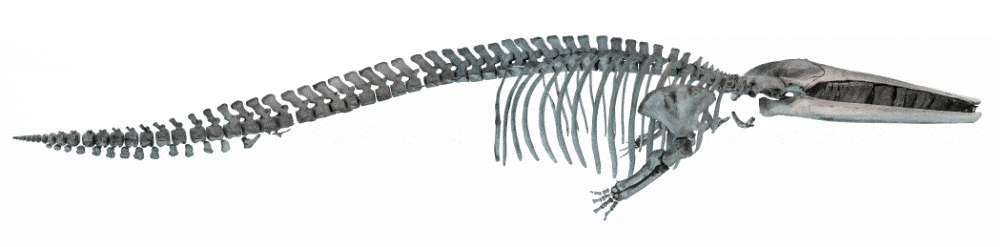
The whale’s ribs are called floating ribs because they do not connect to a bone on the underside.
 CorrectIncorrect
Hint
Find the answer in section M: Click here
-
Question 17 of 18
17. Question
The pink parts of this diagram are cartilage that connect the ribs to the clavicle.
 CorrectIncorrect
Hint
Find the answer in section N: Click here
-
Question 18 of 18
18. Question
We have 4 floating ribs.
CorrectIncorrectHint
Find the answer in section N: Click here